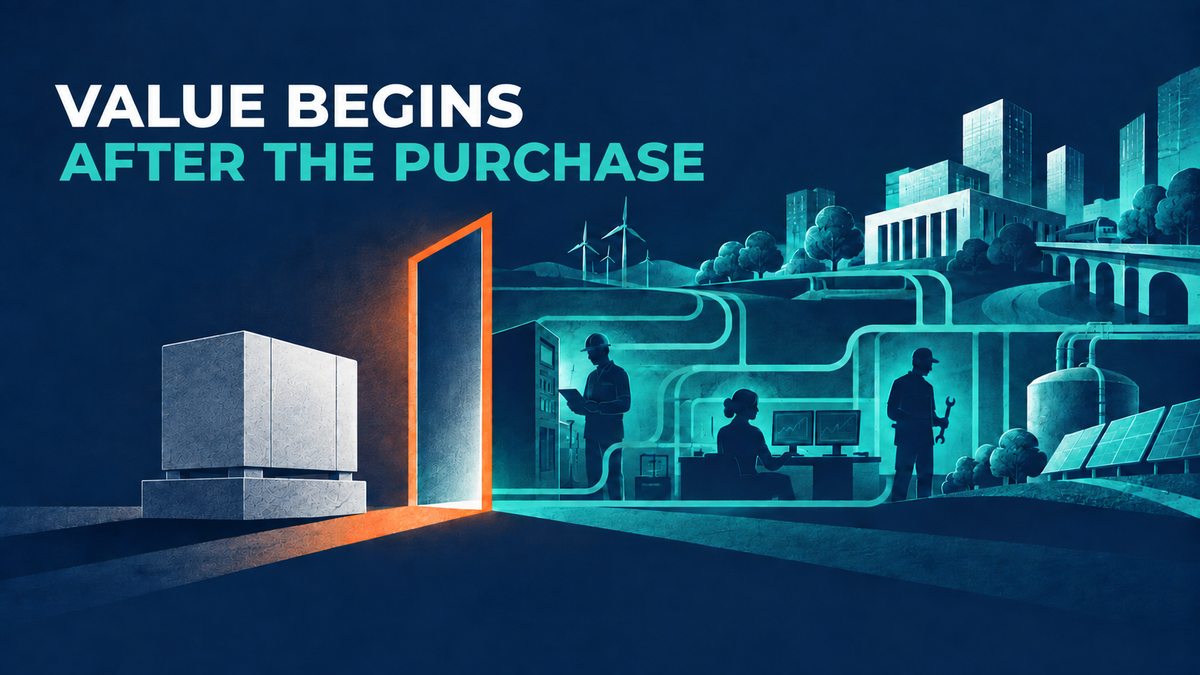
Value Begins After the Purchase

By Leandro Chique
Three key takeaways
- Purchase price is visible. Lifetime value is created through sustained performance.
- Technology becomes capacity only when people, infrastructure and operations work around it.
- Advanced and affordable solutions can both be right. The test is whether they fit the problem and the environment.
A hospital buys new equipment. A utility commissions a substation. A factory installs a production line.
On paper, the investment is complete. In practice, the real economics have only just begun.
The invoice tells us what it cost to acquire an asset. It does not tell us whether the asset will be installed correctly, used effectively, maintained reliably or integrated into the wider system.
Ownership is easy to count. Functioning capacity is harder.
That distinction matters wherever technology is expected to improve essential services, productivity or public infrastructure.
Price is simple. Value is not.
Purchase price is immediate, visible and easy to compare. Value is distributed across time.
A lower-priced solution may cost more once installation, training, energy, maintenance, consumables, software, downtime and replacement are included. A higher-priced solution may justify its cost if it improves performance, reduces risk or supports more demanding operating requirements.
This is the logic behind life-cycle costing. The European Commission, for example, describes life-cycle cost as extending beyond acquisition to include delivery, installation, operation, maintenance and end-of-life costs.
That broader calculation is essential. But cost is only half of the equation.
The more important question is what the investment produces.
Does it improve the intended outcome? Does it remain available when needed? Can the organization operate it consistently? Does it reduce fragmentation or create new dependencies? Will it still be delivering value five or ten years from now?
A useful definition of value is therefore:
The required outcome, delivered reliably and sustainably, at an acceptable lifetime cost.
This definition does not assume that cheaper is better. It also does not assume that more sophisticated is automatically more valuable.
It demands evidence of fit.
Value has four tests
The strongest investment decisions examine at least four dimensions.
1. Outcome fit
What problem is the technology expected to solve?
The starting point should be the required outcome, not the available feature list. In some environments, that outcome requires advanced analytics, integration and automation. In others, reliability, simplicity and rapid deployment matter more.
The question is not whether a solution has more capability.
The question is whether those capabilities materially improve the intended result.
2. Economic fit
Can the organization afford the full cost of operating the solution?
That includes more than the initial purchase. Installation, infrastructure upgrades, training, energy, consumables, software, maintenance, repairs, financing and eventual replacement can all influence the economics.
Predictability matters too. An organization may be able to fund an acquisition but struggle with variable operating costs or exposure to imported parts and services.
Affordability at the point of purchase does not guarantee sustainability over time.
3. Operational fit
Can the organization install, adopt, operate and maintain the technology reliably?
This is where many theoretically sound investments lose value.
WHO guidance on healthcare technology procurement emphasizes that effective procurement involves more than selecting and purchasing equipment. Planning, assessment, installation, training and maintenance all contribute to whether technology can support safe and effective care.
The same principle applies beyond healthcare. Technology creates value through operation, not possession.
If users are not trained, workflows are not adapted, maintenance is unavailable or accountability is unclear, the asset may never reach its expected performance.
4. Local fit
Does the solution work within the environment where it will actually be used?
That environment includes electricity, connectivity, logistics, workforce capacity, regulation, financing and access to technical support.
The World Bank has documented how infrastructure projects in schools and health facilities can underperform when installation is not supported by a viable maintenance and service model. The equipment may exist, but the service it was intended to enable remains unreliable.
The same asset can therefore produce very different value in different places.
Designing for constraints is not a lower standard. It is a more demanding form of design because the solution must perform under real conditions rather than ideal ones.
Complexity must earn its place
Some problems are genuinely complex.
Large organizations may need integrated information, automation, advanced analytics and coordinated workflows. These capabilities can reduce fragmentation, improve visibility and help people make better decisions.
In those environments, a more capable platform may offer the strongest lifetime value, even at a higher initial price.
But complexity is not free.
Every additional capability can bring training requirements, integration work, cybersecurity exposure, governance needs and long-term support obligations. A feature creates value only when it is adopted and connected to a meaningful action.
The same is true of artificial intelligence.
AI can improve detection, prioritization and decision support. But its value depends on validation, appropriate data, responsible governance, workflow integration and the ability of people to act on its output.
An advanced capability that is never used is not value. It is inventory.
Conversely, a simpler solution is not inherently inferior. If it delivers the required outcome more reliably, with lower operational burden and stronger local support, it may be the better decision.
The objective is not maximum sophistication or minimum price.
It is appropriate capability.
Integration creates value and dependency
Technology increasingly operates as part of an ecosystem.
Data moves between devices, software, users and organizations. When these components work together, integration can reduce duplication, delays and errors. It can also make it easier to coordinate decisions across an entire operation.
That can create considerable value.
But integration also creates dependency. Organizations may become reliant on specific interfaces, data structures, service arrangements or software environments. Switching can become more difficult and the consequences of an outage can spread across the system.
This does not make ecosystems undesirable. It means their economics should be assessed honestly.
Buyers should ask:
- Can the system exchange information with other technologies?
- Who controls the data and how portable is it?
- What happens when one component is unavailable?
- How are security updates, upgrades and compatibility managed?
- Can the organization change parts of the system without replacing everything?
- Is the long-term service model financially and operationally sustainable?
An ecosystem should create more value than dependency.
Higher price does not prove value
Total cost of ownership is sometimes used to defend a higher price without making the underlying assumptions visible.
That is not sufficient.
A credible value case should allow the buyer to test its logic. It should explain what outcome is expected, how the technology will be used, what operating conditions are assumed and where costs or risks may emerge.
Useful questions include:
- What measurable outcome is the investment intended to produce?
- Which capabilities are essential, and which are optional?
- What level of availability is required?
- Who will install, operate and maintain the technology?
- What supporting infrastructure is needed?
- What happens when the technology fails?
- Are service, software, consumables and replacement costs included?
- Can the organization expand or adapt the system over time?
- Who carries the operational and financial risk?
These questions do not favor expensive or inexpensive solutions. They favor transparent ones.
The best decision may be a highly capable integrated platform. It may be a robust standalone solution. It may be a combination of both across different parts of the same organization.
Consistency does not always mean using the same technology everywhere. It can mean applying the same decision principles everywhere.
The Venezuela test
This distinction is especially important for countries rebuilding essential services and productive capacity.
Reconstruction plans often focus on what must be purchased or built: hospitals, power systems, telecommunications, water infrastructure, industrial equipment and digital platforms.
But replacing assets is not the same as restoring a functioning system.
A hospital cannot operate reliably without trained people, energy, maintenance, supplies and sound management. A power installation cannot deliver sustained value without service capability, spare parts, payment discipline and accountable governance. An industrial asset cannot create productivity if logistics, financing and workforce capacity remain unresolved.
The harder question is therefore not what can be purchased today.
It is what will still be operating five years from now.
Different parts of a rebuilding economy will require different levels of technology. Some environments may justify advanced, integrated systems from the beginning. Others may need solutions optimized for resilience, rapid deployment and limited infrastructure.
There is no universal answer based on price or sophistication alone.
The right answer depends on the outcome, the operating environment and the institution responsible for sustaining it.
Reconstruction is not the replacement of assets. It is the restoration of functioning systems.
Why it matters
Public institutions and businesses are under pressure to do more with limited capital. At the same time, technology is becoming more interconnected and operationally demanding.
Buying the cheapest option and repeatedly replacing it is not efficiency. It is deferred cost.
Paying for capabilities that cannot be adopted is not transformation. It is stranded potential.
Better decisions begin by connecting procurement to operation.
Buyers should evaluate lifetime economics. Operators should be involved before the purchase. Investors should examine whether the operating model is sustainable. Policymakers should recognize that equipment, infrastructure, people and maintenance are parts of the same system.
The best solution is not necessarily the cheapest one, nor the most sophisticated one.
It is the solution that delivers the required outcome, reliably and sustainably, in the environment where it will actually be used.
The purchase gets an asset through the door.
What happens afterwards determines whether it ever becomes capacity.
The views expressed here are personal and do not represent my employer. This article is based exclusively on public sources and general analysis.
Public references: European Commission on life-cycle costing · WHO Procurement Process Resource Guide · World Bank on sustainable energy for schools and health centres