The Coming Divide Between the Measured and the Unmeasured

Key Takeaways
• Health data is becoming a prerequisite for access, not just a record of care.
• Data inequality is emerging as the next major health inequality cause worldwide.
• Not all “unmeasured” people are the same, and that distinction matters.
• The future of healthcare depends on building a fair and trustworthy data economy.
A New Kind of Divide
Healthcare inequality is not new. Coming from Venezuela where the societal divides between the haves and the have-nots is dramatic gives me that cocky reassurance. Income, geography, education, and race have long shaped who gets care and who does not.
What is new is the role of data?
In an increasingly digital system, access to care, insurance benefits, and even employment opportunities are becoming mediated by health data. Not having data is no longer neutral. It is becoming a disadvantage.
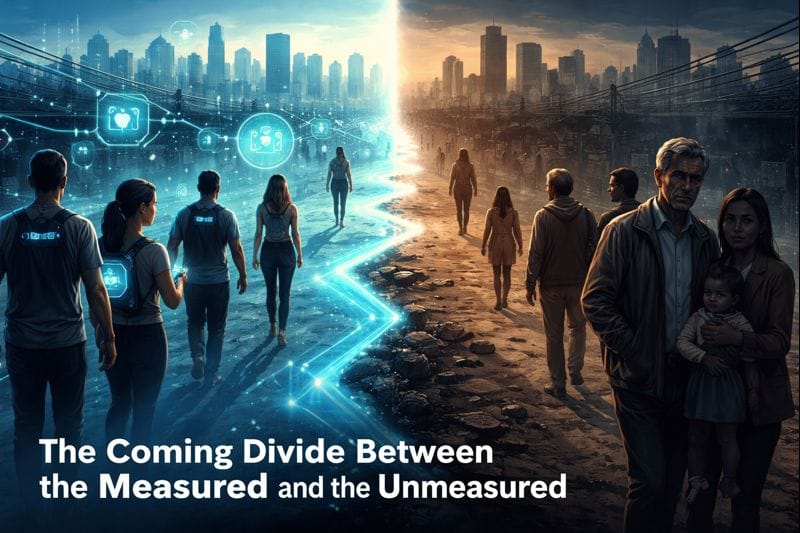
A quiet divide is forming between the measured and the unmeasured.
What It Means to Be Measured
Being measured means more than having a medical record.
It means generating continuous, structured, machine-readable data that systems (and AI) can act on. Data like step counts, sleep patterns, heart rate variability, medication adherence, claims history, predictive risk scores are basics, but the scope will dramatically increase in the coming years as we add more "wearables" to our lives.
For some, this data unlocks benefits. Lower premiums. Faster triage. Personalized care pathways. Earlier interventions.
For others, the absence of data creates friction. More paperwork. Slower access. Generic recommendations. Less confidence from the system.
In digital health, silence is not neutrality. It is uncertainty. And uncertainty is penalized.
How Systems Learn to Prefer the Measured
Algorithms do not discriminate intentionally. They optimize for confidence.
Data-rich individuals are easier to classify, predict, and route. Systems can estimate risk, cost, and outcomes with higher certainty. That certainty is valuable.
Data-poor individuals are harder to model. They introduce ambiguity. And ambiguity increases cost.
So, systems will adapt (already are?). They design pathways that favor those who are already measured.
This is not a moral failure. It is a structural one.
The Three Faces of the Unmeasured
The problem is not that some people are unmeasured. The problem is that systems increasingly treat measurement as a proxy for legitimacy.
Crucially, there is not one type of unmeasured person. There are three.
1. Unmeasured by exclusion
These are people who lack access to devices, connectivity, stable care, or digital literacy. Older populations. Lower-income groups. People moving between systems.
This is classic inequality, now expressed through data.
2. Unmeasured by design
Some lives do not fit cleanly into models. Irregular work patterns. Complex comorbidities. Mental health conditions. Caregiving responsibilities.
These individuals are not invisible by accident. They are difficult to standardize - at least for now.
3. Unmeasured by choice
Some people actively refuse continuous measurement. They value privacy, autonomy, or simply want distance from constant tracking.
This is not disengagement. It is a decision.
Lumping these groups together leads to the wrong conclusion. The answer is not to measure everyone.
When Measurement Becomes a Gatekeeper
Today, health data shapes insurance incentives and care pathways. Tomorrow, it may shape far more.
Employers already use wellness data to design benefits. Insurers reward documented behavior. Health systems prioritize follow-ups based on predictive confidence.
The trajectory is clear. Measurement becomes eligibility.
Not maliciously. Gradually. Invisibly.
The danger is not measurement itself. The danger is when systems confuse legibility with worthiness.
When being easy to model becomes a substitute for being deserving of care.
Why This Inequality Is Different
Traditional health inequality was visible. You could point to underfunded clinics or underserved regions. In Venezuela was very evident, but less so in the Netherlands or USA.
Data inequality is harder to see. It lives inside thresholds, confidence scores, and ranking systems.
You are not denied care. You are simply deprioritized.
You are not excluded. You are just less certain.
That makes this divide more subtle, more defensible, and more dangerous.
The False Comfort of “More Data Is Better”
The instinctive response is obvious. Measure everyone.
But indiscriminate measurement creates new risks. Surveillance. Fatigue. Loss of autonomy. Misuse of intimate data.
The solution is not universal tracking. It is trustworthy participation.
People must understand what measurement does, what it unlocks, and what it costs. And critically, they must not be penalized for choosing not to participate.
Toward a Fair Health Data Economy
If data is becoming a form of access, then it must be governed like one.
A fair health data economy would require:
• Protection against disadvantage for non-participation.
• Clear understanding of how data influences decisions.
• The ability to contribute without being exploited.
• Visibility into who benefits from data use.
• Systems that value inclusion alongside efficiency.
This is not a technical challenge. It is a design and governance challenge.
The Question We Have Not Asked Yet
We spend a lot of time asking how to use health data better. We spend far less time asking who is left behind when data becomes the currency of access.
In a data-driven health system, participation must remain a choice. And opting out must not mean falling behind.
The divide between the measured and the unmeasured is coming - or is already here? The question is whether we design for it deliberately or allow it to harden by default.