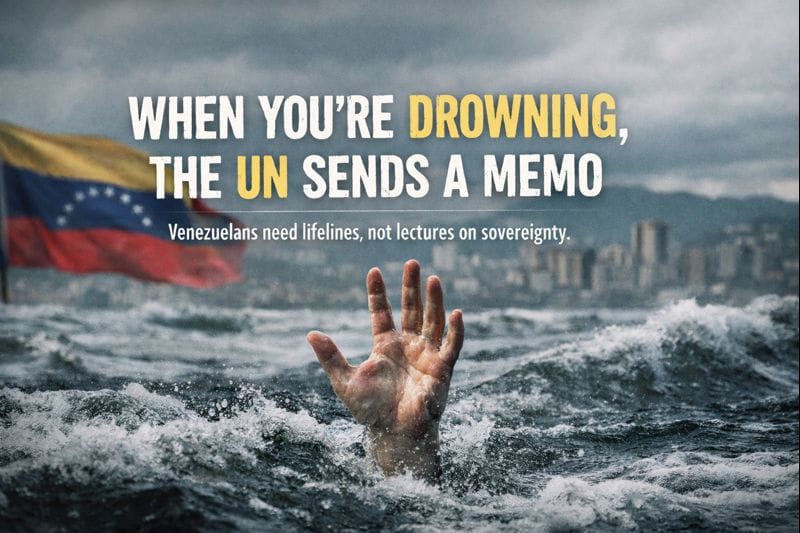
About Venezuela: When You are Drowning, the UN Sends a Memo

3 key takeaways
- This is not about Trump, the U.S., or oil. It is about survival.
- The United Nations (UN) documents repression well. It rarely stops it. (OHCHR)
- Transition is unavoidable when guns are tied to illicit incentives. (Congress.gov)
Venezuelans keep learning the same lesson the hard way: international law is loud in principle and quiet in enforcement.
When you are drowning, you do not debate whose hand reaches you. You take it. You breathe. Then you look around and ask the questions that decide whether you were rescued or simply relocated.
That sequence matters today because the headlines are moving fast, and the system underneath them moves slower. (CSIS)
AGAIN - This is NOT about Trump, the U.S., or oil. It is about exit.
Outsiders love clean motives. “Oil.” “Empire.” “Domestic U.S. politics.”
Those frames are emotionally satisfying because they turn chaos into a storyline. But they also reduce Venezuelans into props inside someone else’s argument.
Here is the signal: Venezuela is a mass-demolition of normal life.
The Venezuelan displacement crisis is measured in the millions. UNHCR puts refugees and migrants from Venezuela at nearly 7.9 million globally. (UNHCR)
People do not leave home at that scale because they got bored. They leave because the baseline rules of life collapse.
The UN was not there for us. It was there to archive us.
To be fair, the UN system has not been silent.
The UN Human Rights Council’s Independent International Fact-Finding Mission on Venezuela has reported patterns of repression, including serious violations and crimes, and has described how state bodies and security forces operate. (OHCHR)
Reuters has reported on these findings, including sustained patterns designed to create fear and control. (Reuters)
But here is the critique that Venezuelans earn the right to make:
Being right on paper is not the same as being present in reality.
The UN is built to document, condemn, and recommend. It is not built to disarm a coercive state. It does not arrest the people it names. It does not control the prisons it describes. It does not guarantee safe passage to the citizens trapped inside.
That is not a moral failure by UN staff. It is a structural limitation of the international order.
And for Venezuelans, structure is fate.
International law is real. Enforcement is political.
The international legal order does not lack rules. It lacks teeth.
The UN Charter prohibits the use of force against the territorial integrity or political independence of states, with limited exceptions, and it places primary authority for collective security in the Security Council. (United Nations)
The Responsibility to Protect framework exists on paper, but it explicitly routes “timely and decisive” action through the Security Council. In practice, that means geopolitics can veto protection. (United Nations)
So yes, “international law” exists. But Venezuelans learned the practical version: if enforcement depends on politics, rights become conditional.
The International Criminal Court (ICC) exists too. The ICC’s Venezuela I situation is active, and the Court’s public materials describe the posture of the case. (International Criminal Court)
But criminal justice is slow, procedurally constrained, and dependent on state cooperation for arrests and access. It can be a future ledger. It is rarely a present shield.
That gap between law and protection is the core story.
Power, not policy, decides outcomes.
Most commentary about Venezuela still treats it like a policy debate. It is not. It is a power structure.
If you want to understand why a transition is hard, do not start with speeches. Start with incentives.
The armed forces are not just “supporters.” They are the system’s insurance.
Multiple credible sources describe corruption and illicit economies intersecting with state and security structures in Venezuela. (Financial Times)
The U.S. Department of Justice publicly charged Maduro and other current and former Venezuelan officials in 2020 with narco-terrorism and related offenses, alleging a long-running partnership with the FARC. These are allegations in a U.S. criminal case, not a neutral adjudication of truth, but they shape risk, leverage, and behavior. (Department of Justice)
CRS briefings describe U.S. government assertions tying Maduro-associated networks to drug trafficking and security threats, and they outline the policy frame being used around “cartels” and armed conflict. (Congress.gov)
Here is the inference that matters for transition design:
When people with guns also face legal exposure and loss of illicit income, “step aside peacefully” is not a normal request. It is an existential threat.
That is why moral purity is not a strategy. Sequencing is.
Transition is not a celebration. It’s a negotiation with reality.
Many Venezuelans want justice. They deserve justice.
But the fastest way to lose justice is to demand it in a way that prevents a transition from happening at all.
A viable transition has to answer one hard question:
What makes the people who control force accept a future where they control less?
There are only a few tools, and none are pretty:
- Security guarantees that prevent immediate bloodshed.
- Conditional legal pathways that separate the worst crimes from the broader apparatus.
- A credible exit ramp for parts of the coalition, to split the coalition.
- Rapid institutional capture of the basics: courts, electoral authority, prisons, intelligence services.
This is not a plea for impunity. It is a recognition of mechanics.
If you ignore mechanics, you get either:
- No transition, just crackdown.
- Or violent transition, followed by cycles of revenge.
Neither builds a country.
The cleanest critique of the UN is also the most damaging
There is a deeper reason Venezuelans feel abandoned.
The UN system, by design, places sovereignty above rescue, unless the Security Council agrees otherwise. (United Nations)
So the same order that says “never again” also tells you, in practice, “not like this.”
That contradiction is not just frustrating. It is radicalizing. It pushes people toward the only thing that seems to work: raw power.
This is why a transition must be followed immediately by institution-building. Otherwise the precedent becomes: force wins.
What accountability should look like after the headline
If you want “transition” to mean “freedom,” the measurable commitments are not rhetorical.
They are operational:
- Publish verifiable electoral results and restore legal audit processes. Human Rights Watch has criticized the failure to release precinct-level tally sheets and conduct required audits. (Human Rights Watch)
- End incommunicado detention and restore access to counsel and family. (Human Rights Watch)
- Open prisons and security agencies to real monitoring.
- Create a sequencing plan for prosecutions: prioritize top-command responsibility for systematic abuses documented by credible bodies, not collective punishment. (OHCHR)
- Break the illicit incentive chain: transparency on military-linked businesses, illicit mining routes, and trafficking protection arrangements. If that chain stays intact, the old system regenerates under new branding. (Global Initiative)
Accountability is not a slogan. It is an architecture.
Why it matters outside Venezuela
Because Venezuela is not only a tragedy. It is a template for what happens when:
- Institutions fail slowly.
- Illicit economies become governance.
- The international system mistakes “naming” for “stopping.”
It also matters because the Venezuelan diaspora is already a structural fact across the region, and millions are watching for signals strong enough to justify return. (AP News)
My personal position
This is the line that survives both cynicism and propaganda:
Take the hand. Then build a ladder.
Grab the hand because survival comes first.
Demand the ladder because a country cannot be rebuilt on gratitude, rumors, or foreign narratives.
And yes, be honest about the UN and international law: for Venezuela, they often arrived as reports after the damage, not protection before it. (OHCHR)
When you are drowning, you take the hand. When you’re breathing again, you build a system that never lets people drown in silence.